You just fired up your Blackstone for the first time.
The burners are roaring. The surface is starting to shimmer. And you’re standing there thinking — “Wait, how hot does this thing actually get? Am I about to burn everything?”
It’s one of the most common questions new Blackstone owners ask — and honestly, one of the most important. Because understanding how hot does a Blackstone get is the difference between perfectly seared smash burgers and a pile of charcoal.
So let’s break it all down — max temperatures, heat zones, ideal cooking temps for every food, and exactly how to control your griddle like a pro.
Table of Contents
How Hot Does a Blackstone Get? The Real Answer
Let’s cut straight to it.
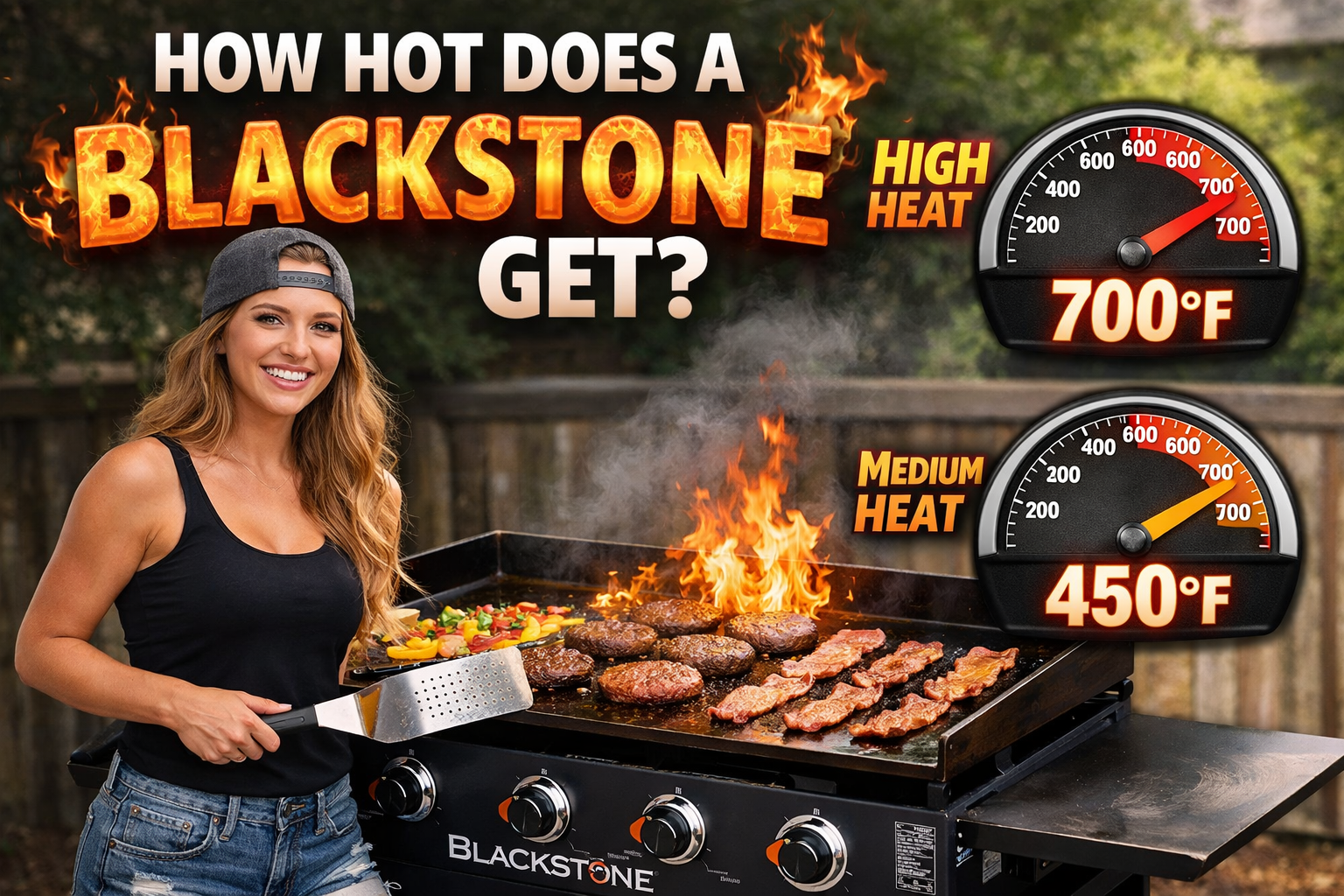
Blackstone griddles can heat up to between 500° to 650°F, depending on the model you purchase. My Backyard Life
But real-world testing tells an even more impressive story. Real-world temperature testing of Blackstone griddle models reveals maximum temps of 635–640°F, actually beating manufacturer claims. Griddle King
Here’s a quick model-by-model breakdown based on actual testing:
| Blackstone Model | Max Temperature | Heat-Up Time |
|---|---|---|
| 17″ Adventure Ready | 640°F | 8 minutes |
| 28″ Flat Top Grill | 635°F | 8.5 minutes |
| 36″ 4-Burner | 500–560°F | 9 minutes |
| E-Series Electric | 502°F | 8 minutes |
The smaller propane models actually get hotter than the larger ones — because the same BTU output is concentrated over a smaller surface area.
But here’s the thing — just because it CAN get that hot doesn’t mean you SHOULD cook at that temperature. Under ideal conditions, Blackstone’s gas griddles can reach over 650°F, but there are very few instances where you would ever need to cook at this high temperature. Blackstone Products
Blackstone Official Temperature Guide — What Each Setting Actually Means
Blackstone itself has published an official temperature guide, and it’s incredibly useful. The Blackstone griddle temperature guide breaks down as follows: Keep Warm is 200–225°F, Low is 250–300°F, Low-Medium is 300–325°F, Medium is 350°F, Medium-High is 375–400°F, High is 425–450°F, and Very High is 450–550°F. Blackstone Products
Let’s make sense of what each zone actually means for your cooking:
Keep Warm (200°F – 225°F)
Food is already cooked — you’re just keeping it warm while other things finish. Great for toast, cooked bacon, or pancakes waiting for the rest of the batch.
Low (250°F – 300°F)
Gentle cooking. Perfect for sweating vegetables, melting butter, or cooking delicate fish that needs low, consistent heat.
Low-Medium (300°F – 325°F)
The ideal range for eggs. Eggs have an ideal surface range of 300–325°F. Blackstone Griddle 101 Also great for pancakes, French toast, and quesadillas where you want even browning without burning.
Medium (350°F)
Your everyday cooking zone. Chicken breasts, sausages, grilled sandwiches — most weeknight cooking happens right here.
Medium-High (375°F – 400°F)
You can cook almost anything on a griddle between 300°F and 375–400°F and have consistently wonderful results. This happens because of the Maillard reaction — the temperature at which food tends to brown. Blackstone Products Smash burgers, stir fry, shrimp, and vegetables all shine at medium-high.
High (425°F – 450°F)
Searing zone. Steaks, thick burgers, pork chops — anything that needs a deep, dark crust. Cook on high for 1–2 minutes per side, then finish at medium.
Very High (450°F – 550°F)
Maximum searing power. Any good searing to a truly caramelized, deep-brown crust usually requires a high heat of at least 500°F. BBQ Grill Fit Reserved for professional-style sears on ribeyes, scallops, and smash burgers.
Blackstone Temperature Guide for Every Food
Here’s exactly what temperature to cook your favorite foods at:
| Food | Ideal Temperature | Notes |
|---|---|---|
| Eggs | 300°F – 325°F | Low-medium, cook last |
| Pancakes | 325°F – 375°F | Even browning |
| Bacon | 325°F – 375°F | Medium, render fat slowly |
| French Toast | 325°F – 350°F | Medium, don’t rush |
| Sausages | 350°F – 375°F | Medium, rotate often |
| Chicken Breast | 375°F – 400°F | Medium-high, cook through |
| Smash Burgers | 400°F – 450°F | High heat, fast smash |
| Steaks | 450°F – 500°F | High, quick sear both sides |
| Shrimp | 375°F – 400°F | Fast, 2 min per side |
| Fried Rice | 375°F – 425°F | Hot surface, constant movement |
| Vegetables | 350°F – 400°F | Medium-high, quick toss |
How Hot Does a Blackstone Get — and How Fast?
Speed matters when you’re hungry and your family is waiting.
The propane-powered Blackstone griddles can reach their maximum temperatures in about 8 to 9 minutes after lighting the burners. My Backyard Life
That’s faster than your oven preheats. Faster than charcoal reaches cooking temperature. And almost as fast as your kitchen stovetop.
All tested Blackstone models reached maximum temperature in 8–9 minutes — this consistency across different sizes and fuel types makes meal planning predictable. Griddle King
Pro tip — don’t walk away and forget about it. Don’t let it preheat for too long, as the surface can overheat. If you start prepping inside and leave the griddle for 20 minutes, it could get way hotter than you wanted. Blackstone Griddle 101
Understanding Blackstone Heat Zones
Your Blackstone doesn’t heat evenly across the entire surface — and that’s actually a feature, not a flaw.
In propane griddles, gas tubes run underneath the cooking surface in specific patterns. Areas directly above these tubes receive the most intense heat, while spaces between tubes and the griddle’s edges typically run cooler by 50–100°F. Griddle King
Here’s how to use heat zones to your advantage:
Hot Center Zone (450°F+) → Steaks, smash burgers, searing Medium Middle Zone (375°F–425°F) → Chicken, shrimp, stir fry vegetables Cooler Edge Zone (300°F–350°F) → Eggs, pancakes, keeping food warm
Use cooler areas for delicate items and hotter areas for searing. Blackstone Griddle 101 Once you learn your specific griddle’s heat zones, you can cook multiple things at completely different temperatures — all at the same time.
Outdoor Gas Grill with Side Burner – Is It Worth the Extra Burner?
How to Measure Your Blackstone’s Temperature Accurately
Don’t guess. Measure.
The most efficient way to determine the temperature of your griddle is to use an infrared thermometer. Simply hover the thermometer over your griddle surface and within a few seconds, it will tell you the temperature. Blackstone Products
An infrared thermometer costs $15–$30 on Amazon and is one of the best investments a griddle owner can make. You shouldn’t rely on the knob settings because they don’t tell you the actual surface temperature. Different griddle sizes produce very different heat levels even if the knobs are set the same, since all burners heat one solid surface. Blackstone Griddle 101
Water Drop Test — No thermometer? Sprinkle a few drops of water on the surface. If they sizzle and evaporate instantly — you’re at medium-high or above. If they just bubble slowly — you’re at medium or below.
Why Won’t My Blackstone Get Hot Enough?
This is one of the most common problems Blackstone owners face — especially beginners. Here’s what to check:
1. Propane Tank Issues The most common culprit. The gas supply hose may have an object or debris blocking its way, or the line could have a leakage. The last minutes of your cooking may not have a flame hot enough when the gas tank is almost empty. BBQ Grill Fit Always start with a full or near-full tank.
2. Blocked Burner Ports The gas jets or ports on the burners can be blocked by food debris or rust, or the venturi tubes can be blocked by critters like spiders or rust build-up. BBQ Grill Fit Clean your burners regularly to maintain full heat output.
3. Regulator in Safety Mode If you turned the propane on too fast, the regulator may have gone into safety lockout mode — limiting gas flow and heat. Fix: Turn everything off, disconnect the hose, wait 30 seconds, reconnect slowly, then light normally.
4. Wind and Cold Weather Strong winds can make cooking challenging and affect the temperature of your grill or even put out your fire. Wind screen guards can shield from these challenges. Grill Cuisines Always position your Blackstone in a wind-sheltered spot or use the built-in windscreen.
Pro Tips for Controlling Blackstone Temperature Like a Pro
Preheat low and slow. Start by preheating all burners on low, even if you don’t plan to use them all. This prevents warping and allows the heat to distribute evenly. After 15 minutes, check the temperature with your infrared thermometer. Blackstone Griddle 101
Cook in the right order. Start with foods that need the most heat and time — potatoes, thick meats. End with the most delicate foods — eggs last, always.
Turn off burners to cool down. It’s hard for most griddles to maintain lower temperatures on a low setting. Cook eggs after turning off the burners and letting the surface cool down — it’s an easy solution. The Flat Top King
Use a dome. A griddle dome or cover traps heat and creates an oven-like effect on your griddle surface — perfect for melting cheese on burgers or cooking thick proteins all the way through.
Is a Blackstone Hot Enough to Sear a Steak Properly?
Absolutely — and then some.
A proper restaurant-quality sear needs at least 450°F–500°F of direct surface heat. Blackstone’s gas griddles can reach over 650°F under ideal conditions Blackstone Products — well above the minimum needed for a perfect sear.
The key is patience. Let your Blackstone preheat fully, crank the relevant burner to high, and press that steak flat onto the surface for 2–3 minutes without moving it. That’s how you get a crust that rivals any steakhouse.
Final Answer — How Hot Does a Blackstone Get?
Here’s the complete summary:
- Maximum temperature: 635°F–650°F (propane models)
- Electric models: Up to 502°F
- Heat-up time: 8–9 minutes to maximum temp
- Best everyday cooking range: 350°F–425°F
- Ideal searing temperature: 450°F–550°F
- Egg and pancake temperature: 300°F–325°F
Your Blackstone gets seriously hot — hot enough to sear steaks, cook breakfast, and handle anything in between. The secret isn’t just the maximum temperature — it’s learning how to use every zone of that heat to cook like a pro.
Outdoor Gas Grill with Side Burner – Is It Worth the Extra Burner?